Clarity needs context. Teams can only be clear about where they are going, what is happening and who does what when the context behind it is explicit, shared and kept up to date. Many companies are now paying attention to context because of AI, and I hope this raises awareness of context and how we handle and share it, with humans and with AI.
At the same time, I know my impressions rely on the companies I work with directly and a few anecdotes, so I ran a survey to get a broader sample of how different product organisations currently handle context information. I'm sharing the findings here to inform more nuanced conversations about how we best leverage the power of context.
In short
I asked product people how their teams create and keep the context that people and AI tools need. Over 50 responded, most of them working at European companies. Nearly all of them use AI every day, so read this as a snapshot of engaged practitioners, not as a representative benchmark. Six things stood out:
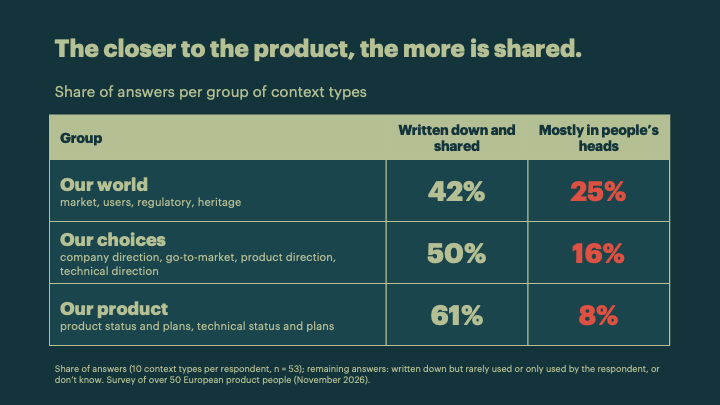
The closer context sits to the product, the better it is covered. Context about the world around us (market, users, regulation, heritage) is written down and shared in only 42% of cases. For product status and plans, it is 61%.
Heritage is the most implicit kind of context. About half of the respondents say the history that explains otherwise surprising decisions only lives in people’s heads.
Personal AI use is ahead of team AI use. For users, product direction, company direction and market, two-thirds of the context people have written down is used in their own AI tools, but only 41% in their team's.
Context goes stale quietly. Of the people who responded on their update practice, only 3 name a person or role responsible for keeping it current, and a quarter cannot say when their main shared context was last updated.
The benefit is felt, not measured. 60% of those who rated the impact of providing context say that it has changed how their team works together for the better. But only 4 measure it with metrics.
AI may be a good reason to fix what people needed anyway. The changes respondents describe are mostly about people: fewer questions to the same few colleagues, quicker onboarding, a shared understanding of direction.
Why I asked, and how to read the numbers
My starting point is that clarity is an outcome, and that context is what we can work on. AI has made that practical. An AI tool can only work with the context it is given, so teams that start using AI quickly learn which context is written down, where it lives, and whether anyone keeps it current. My hope, and the reason for this survey, is that this new attention to context helps people at least as much as it helps the machines.
The survey ran until mid-November 2026 and received 53 complete responses. I asked about ten pre-selected kinds of context. For each, people said whether it lives mostly in people's heads, is written down but rarely used or hard to find, is written down and only they use it, or is written down and shared with the colleagues who need it. I grouped the ten kinds into three:
Our world: market, users, regulatory, heritage
Our choices: company direction, go-to-market, product direction, technical direction
Our product: product status and plans, technical status and plans
Who answered. 29 product leaders and 16 product managers make up 85% of the sample; the rest are consultants, coaches, designers and one engineering leader. 51 of 53 use AI tools daily. The products are mostly B2B software, from start-ups to companies with more than 1,000 people. All respondents identified as being from Europe, so please read this from a European perspective.
To illustrate the mix of companies, the logos below show where some of the respondents work.

How to read the numbers.
The sample is self-selected and AI-engaged, so it is likely not representative, despite the broad mix of companies.
There are only 53 responses, and for some questions even fewer, so read the percentages as an indication.
All answers are the subjective views of individuals in those organisations.
Part 1: The state of context
The closer to the product, the better it is covered
The further removed a type of context is from the product itself, the more it tends to exist only in people's minds. Regarding what we face and inherit (market, users, regulations, heritage) only 42% of respondents indicated that this information is documented and shared, while 25% believe it mainly resides in people's heads. For the decisions we make, 50% say it is documented and 16% believe it exists primarily in minds.
When it comes to what we are building, 61% report that it is documented, and only 8% think it exists mostly in people's heads. Overall, teams are more diligent about documenting what they create than what they confront.
Heritage: the context that lives in heads
Heritage is the most implicit kind of context by a wide margin. About half of the respondents say it lives mostly in people's heads. The next highest are go-to-market (19%) and users and regulatory (17% each). Only 13 respondents (25%) have heritage written down and shared.
When I asked which types of context they would most miss, only 4 of 53 respondents chose heritage, which made me reflect on my initial choice to include it. But I'm still sure that, while admittedly difficult to capture, heritage is a very relevant type of context information: In particular, for explaining surprising behavior in a team or a product, the explanation often lies in aspects of heritage. Some examples:
company's heritage: making money was considered evil for a long time when the company still ran on external growth money
tenured trust: colleague X has been working with our CEO for over 10 years, which explains a level of influence you wouldn't expect from someone in their role
conditioned behavior: the previous CEO micro-managed developers, which is why engineering leaders became allergic to any kind of specific ideas from superiors
previous learnings: one of the respondents mentioned a team that, over the years, exchanged every person, didn't know the product decisions of the past and did a whole discovery on something that was already invalidated
Written down is not the same as used
Context that exists in writing is not context that is used. 77% of all answers say a type of context is written down, but only 49% say it is shared with the colleagues who need it. Nine in ten respondents have at least one type that is written down but rarely used, hard to find or used by themselves alone.
I don't think this surprises anyone who has opened their company's wiki or Confluence. We all know the Confluence space with too much information that hardly anyone uses, and the numbers mostly confirm what practitioners experience first-hand. The more interesting question is what changes now.
With AI, more companies pay attention to their context, because a tool that cannot find or trust it is useless in a very visible way. I hope that this attention, together with automated updates, leads not only to context being shared more consciously among humans, but to a more sustainable and actionable way of handling context information.
One more hint points the same way. Respondents who have been with their organisation for longer report more context as written down and shared than those who joined recently. The survey cannot say why. My interpretation is that people who have been around seem to find information more easily - or simply know what's worth looking for, while newcomers, who need the context most, can't know this. This also points to a common blind spot in human context handling: I've often found that tenured team members take their understanding of context for granted and miss the opportunity to actively bring new colleagues along.
Technical context is not better covered - or product people are not aware
I expected technical context to be better covered than the product "why". In this sample, it is not: the two technical context kinds are written down and shared in 53% of cases, compared with 61% for company direction, product direction, and product status and plans. Technical status and plans also have 13% "don't know / not applicable". The respondents are product people, so this shows how they see technical context, not what engineering teams have.
Part 2: Context and AI, personal versus team
I asked two questions about AI: which of the ten kinds of context people use with their own AI tools, and which they use with their team's AI tools. In the comparisons below, I only count context that a respondent has said is written down in some way.
Half of the respondents maintain context for AI across the team
49% deliberately maintain shared context for AI for their whole team or organisation. Another 28% are starting or experimenting. Together, that is 41 of 53 (77%) - that is more than what I had expected: I had assumed that maintaining context predominantly still was a "single-player game" and was positively surprised. Among these engaged practitioners, shared context for AI is clearly no longer a niche practice.
Where context lives
The wiki or docs tool is still the default (79%), followed by product tools such as Jira or Productboard (60%) and repo files (57%). Personal notes or prompts are named by 34%, a shared space in an AI tool by 28%, and 21% say context also lives mostly in people's heads. People name roughly three places each.
I was positively surprised that such a high share of product people in the sample already use repo files, which until recently were pretty much an engineering-only terrain - this is particularly relevant when thinking about more systematic versioning and using AI to keep context updated.
If it works in your own AI, share it with your team's
This is the finding I find most useful. Take the four kinds of context closest to the product's direction: users, product direction, company direction and market. When respondents have them written down across these four kinds, 67% use them in their own AI tools but only 41% in their team's. That is a 26-point gap: even when context is written down, it is used less often in the team's AI tools than in people's own. In comparison, technical context is equal across both.
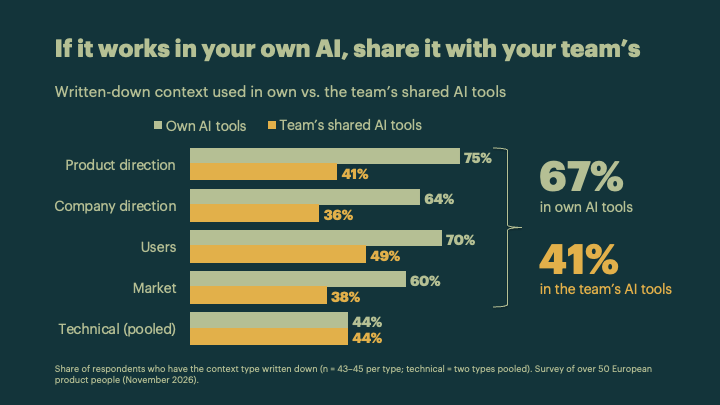
I read the gap for product-related context as potential: The context already exists, and it already works for one person - why not share it more broadly? Even more so, given that it is the same types of context information people say they would miss most if it weren't there.
Shared does not mean AI-ready
Of all the context information respondents say they write down and share with colleagues, 30% isn't used with any AI tool. Not every kind of context needs an AI tool, so this is not a gap by itself. But it suggests that "we have documented it" and "our AI can use it" are two different states.
Heritage is a blind spot twice over
Half of the respondents say heritage lives mostly in heads. Of those who have it written down, still only 27% use it with any AI tool, significantly less than how other types of written context information is shared with AI tools. The group is small, but it fits the story in Part 1: the history behind our products is the context that people, and their AI, are least likely to have. Realistically, some of the heritage context (for instance, explanations of why certain tenured colleagues have surprising “CEO whisperer” influence) are better suited for informal, spoken context sharing anyways.
Team-wide AI usage correlates with a higher share of written documentation
The 26 respondents who maintain context for AI across the whole team have about six of the ten kinds written down and shared, against four for everyone else (6.0 against 3.9). They more often keep context in repo files (73% against 41%) and less often rely on personal notes (19% against 48%) or on heads (8% against 33%).
The data cannot prove cause and effect. But if the teams that maintain AI context together are also the ones that changed how they handle context because of AI, that supports my hope: AI-driven attention to context leads to more context being made explicit, which can potentially help the people in those organisations too.
Part 3: Keeping context alive
Context decays. In this part, the picture is that the team collectively keeps it current, or nobody in particular does. And that the benefits of sharing context are felt but rarely measured.
Because of a flaw in my survey logic, only 42 of the 53 respondents received these questions, and the missing responses are from cases where fewer kinds of context are written down and shared, so the following numbers may be skewed.
Who writes it
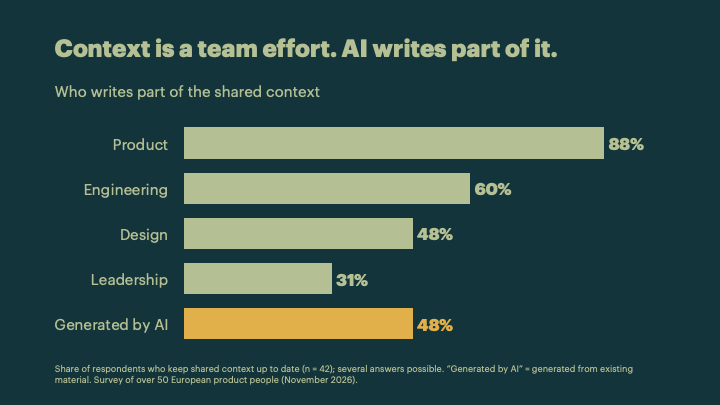
Context is a team effort with product at the centre. Product people write part of it in 88% of cases, engineering in 60%, design in 48% and leadership in 31%. Most respondents work in product roles and may not be aware of everything that engineers contribute, so the engineering figure is probably an underestimate.
The number I would stress is the next one. 20 of the 42 (48%) say that AI generates part of the context from existing material. AI is already a co-author of the context it reads. That changes how context comes into existence, and it raises the question of who checks what the AI wrote.
Who owns it
Keeping context current is rarely anyone's named job. Only 3 of the 42 name a person or role. Half say "the team collectively", 29% say nobody in particular, and 14% say whoever notices it is wrong. So 43% of our respondents have no designated responsibility, and I also wouldn't read "the team collectively" as a success.
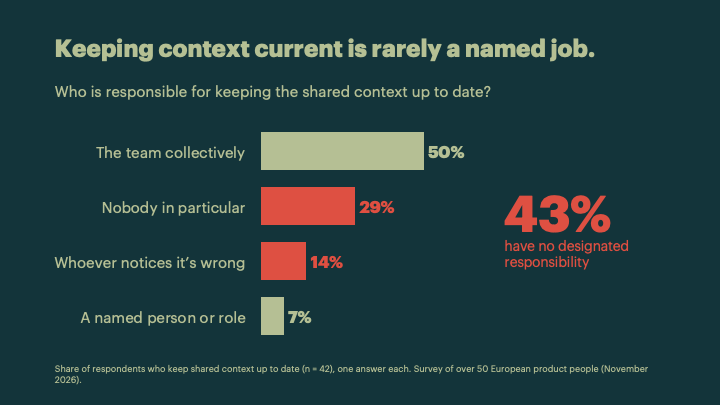
If you imagine a tight, very mature team, then this will probably work (same as with "if you see it, fix it"), but based on my experience with other responsibilities, I have more often found that if everybody kind of owns it, nobody really owns it, and things easily fall through the cracks whenever everybody's busy or distracted with other things.
One respondent also stated that "Having one person that is responsible for the agent or process" had been the main success factor for improving the clarity of their work through context, and I clearly lean toward this as a good practice as well.
How fresh it is, and who cannot say
Context goes stale quietly, so I also asked people how recently the mail shared context was updated. While 53% of respondents said their main shared context was updated that week, if not that day, the other half update less frequently. Most worrying, 26% of participants said they don't know.
This is obviously problematic because if you cannot tell when your team's context was last touched, it is hard to know how far to trust it.
So, apart from more awareness and clear responsibility, the question is how to organise more frequent context updates, and here AI may help - not only as a consumer of context information, but also as one of the solutions for keeping it fresh.
AI in the updating
And indeed, two-thirds of the respondents already let AI or automation do some or most of the updating; 21% even state that in their case AI does "most" of the updating.
But using AI to help with keeping the context fresh is not a guarantee for frequent updates (only 78% of those where AI does most of the updating updated as recently as the same week), and you can also keep your context fresh without AI (3 out of 9 who use no AI for updates at all still updated weekly or more often).
My reading is that while AI helps when you have clear practices for what should be updated when, you still need to invest in thinking this through up front.
Felt, but rarely measured
Overall, most respondents share my optimism that shared context information improves collaboration: 5 of 42 (60%) say shared context has changed how their team works together for the better (17 clearly, 8 somewhat). But when asked how they know, only 4 respondents said they measure the effect; for the rest, it's more of a feeling. This isn't totally surprising because measuring improved collaboration and measuring the impact of AI are both tricky, but moving forward, I think it will be important that, if we want to secure continued attention on context handling, we find ways to show the positive impact.
If any of you are able to share how you measure the impact of shared context on collaboration, this might be valuable for others to hear as well.
Part 4: What leaders contribute
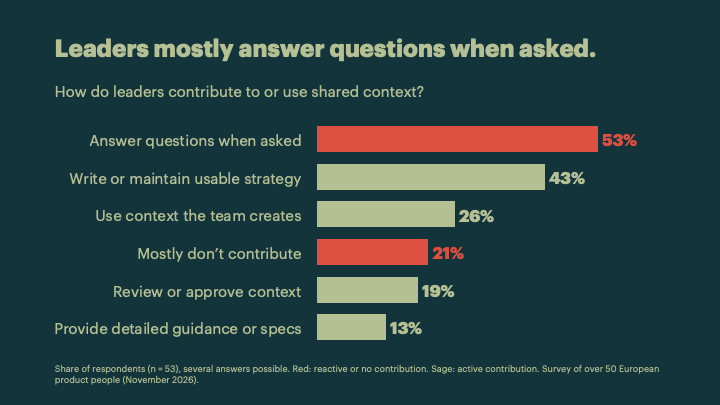
Interestingly, leaders' involvement with context is mostly reactive. I asked everyone how the leaders in their organisation contribute to or use shared context, with several answers possible. The most common type of contribution, named by 53%, is that leaders answer questions when asked - and sometimes this is the only way leaders contribute.
43% say leaders write or maintain strategy in a form the team can use.
Far fewer say that the leaders actively review or approve context (19%) or provide detailed guidance or specs (13%). 21% even say their leaders mostly do not contribute at all.
My suggestion: as a leader, don't wait to be asked; use context as a chance to provide (or correct) direction.
For all the leaders who are involved only reactively, or not at all, this is a missed opportunity. Leaders have access to information nobody else has, take part in meetings their teams are not part of, and know what is happening in the rest of the organisation. Of course they cannot share everything they know, but they do know things worth sharing to help their teams act with more clarity. By actively leading with context, they can create clarity for their teams. Some examples of what that can look like:
Make the direction explicit and available, bring people along with the rationale behind it, and show how everyday work connects to it.
Document decisions and codify some of them into principles, and practise "reading the situation" together with the team.
Explain the heritage behind surprising behaviour.
Define what good looks like in a competency matrix, discuss it with the team, and explain what is happening in other departments.
Establish shared terminology, frame actively, and find out what actually landed.
And if you are not a leader yourself, make them aware of unclear context and show them how they can contribute.
Part 5: In respondents' words
Three questions let people answer in their own words.
What went wrong
Many respondents described what went wrong when context was missing or outdated. The most common failure is not missing context but stale or misunderstood context.
The largest group of stories shows this for direction and priorities: engineers building on old specs after leadership changed the priority, or teams working on the same topic without knowing about each other. One respondent describes “engineers spending days and weeks on outdated priorities”.
But stale context isn't limited to human colleagues; many also cite examples of AI failing when it works from poor context. One person describes it like this: “A stale pointer sent my agents to an old copy of the repo. They worked confidently from outdated product docs until I noticed.”
Other failure stories describe discovery output that looks convincing but isn't, hours of manual work to check and verify results, and money spent on tokens that was lost. Smaller groups of stories are about lost history (see Part 1), lost trust and rework.
What helps
I asked for one practice that helps people keep context useful and up to date. I grouped the answers, and three similarly sized groups stand out: rituals and regular conversation, automation, and ownership.
Automation: update where the work happens. The automation answers share one idea: make updating a by-product of work that is happening anyway, when a ticket closes, in the same pull request, at the end of a delivery.
Rituals: make it a habit of the team. These range from a monthly review session and demos of how colleagues use AI to meeting rituals and feedback loops with leadership and key accounts.
Ownership: someone is responsible. One organisation set up an AI enablement team that drives the work for the rest of the company. Others named one person responsible for the agent, or simply clear responsibilities.
One respondent reminded us that more context is not always better and recommends to "keep the rule files short: long instruction files make for long, worse answers.”
What changed in how teams work
Where people describe what changed, it is mostly about people and access, not about AI output. The most common themes are a shared understanding of direction or goals, and self-service and easier access to information. Fewer mention speed, faster onboarding, or consistency and quality. Some describe fewer interruptions: “Fewer questions asked to 'bottleneck information holders'. People can resolve questions, analytics data, how to design xyz, themselves.” Others describe alignment: “Everyone is on the same page, and thus is rowing in the same direction”.
This part of the survey best supports my main point. From the start, I hoped our current attention to context, triggered by AI, would help people as much as the AI.
What to test in your own team
Based on our insights from the survey, here are some suggestions for you to test within your team:
1. Leverage AI's Attention: The survey responses highlight that many of the perceived benefits of AI focus on people. These benefits include fewer queries directed to the same colleagues, a shared understanding of goals, and quicker onboarding. If AI has sparked interest in your organization regarding its context, capitalize on that momentum while also fostering beneficial habits for your team.
2. Share Beyond Your Personal AI Setup: Often, relevant information that works well within individual AI tools does not reach the wider team. Make an effort to share this context more broadly across your group.
3. Recognize Historical Context: Heritage often represents an implicit kind of context that teams tend to overlook until they repeat previous mistakes. Starting with a decision record—detailing the rationale behind decisions and the individuals involved—can be a simple yet effective way to aid both your team and AI systems.
4. Integrate Updates into Work Processes: Make regular updates a natural part of your work by linking them to existing events, such as closing a ticket, merging a pull request, or completing a delivery. This approach aligns with practices shared by survey respondents. Additionally, designate a specific person or role responsible for these updates, ensuring that they don't rely on whoever happens to notice.
What are you taking away from these results? Anything in particular that surprised you?
I'm curious to hear from you!